Egyptian mango peak season is open, and IBIC Group is taking orders for the 2026 crop. This is the cornerstone guide for international food manufacturers, beverage producers, dairy companies, bakery suppliers, baby-food processors, retail private-label brands and foodservice distributors who want to lock in supply while Egyptian mango is in season.
The guide covers what formats are available, how IQF mango is processed at our facility, what the common B2B applications are, what mango puree specifications typically look like, what packaging options exist, and what to ask your supplier before placing a programme.
Why Source IQF Mango from Egypt?
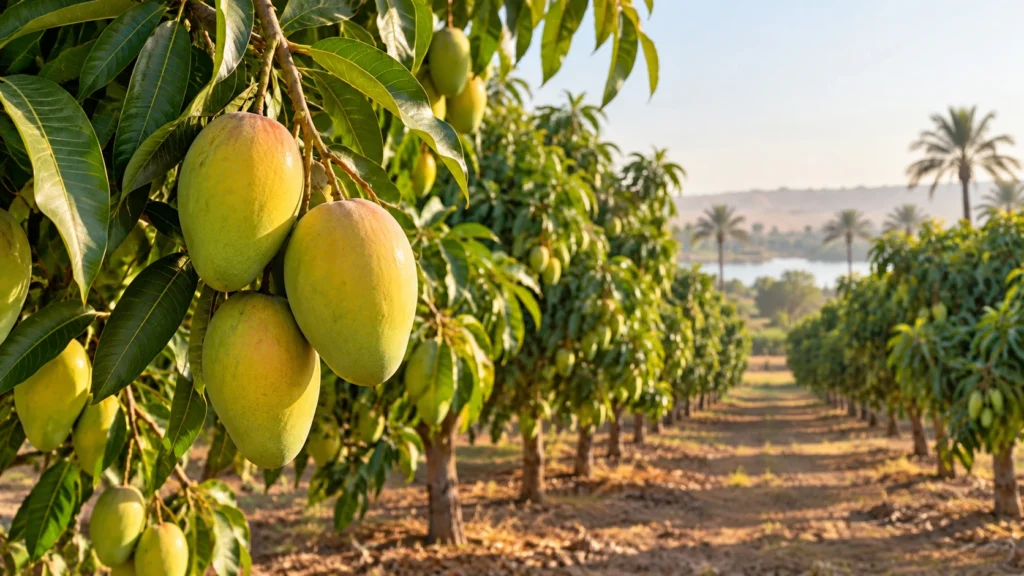
Egypt produces mango in the Nile Delta and Upper Egypt regions, and the country has become a recognised origin for B2B buyers who want year-round programme flexibility combined with competitive freight to Europe, North America, the GCC, Russia and Africa. Key reasons buyers evaluate Egyptian mango:
- Nile Delta and Upper Egypt growing regions with the heat units mango needs to mature on the tree.
- Short transit times to Europe (typically days, not weeks) and competitive transit to GCC and African ports.
- Documented exporter quality systems – Egyptian exporters serving the EU, US, GCC and Russia typically operate under ISO 9001, ISO 22000, FSSC 22000 and FDA registration.
- Multilingual export teams – Egyptian exporters commonly operate in English, Arabic, Italian, Russian and French.
The 2026 Season: Window and What It Means for Buyers
Egyptian mango harvest typically runs from mid-summer into early autumn, with peak volumes in the late summer weeks. For B2B buyers, the practical implications are:
- Peak volume weeks – the highest availability of raw material for IQF processing.
- Pre-season and late-season – narrower variety of formats available; supply may need to be confirmed case-by-case.
- Container consolidation – a 40-foot reefer typically holds roughly 20-24 metric tons of frozen mango depending on packaging format.
If your programme needs volume for the autumn-winter manufacturing cycle, the September peak is the natural window to confirm supply. For programmes running year-round, the late-season IQF stock combines with the next season’s early processed stock to give continuity – this is something to discuss with your supplier.
See IBIC’s Season Calendar for indicative seasonal availability across the full portfolio.
IQF Mango Formats Available
IBIC Group offers three mango formats from the 2026 season. Each format suits different end uses, and buyers often run more than one format in parallel.
1. IQF Mango Cubes
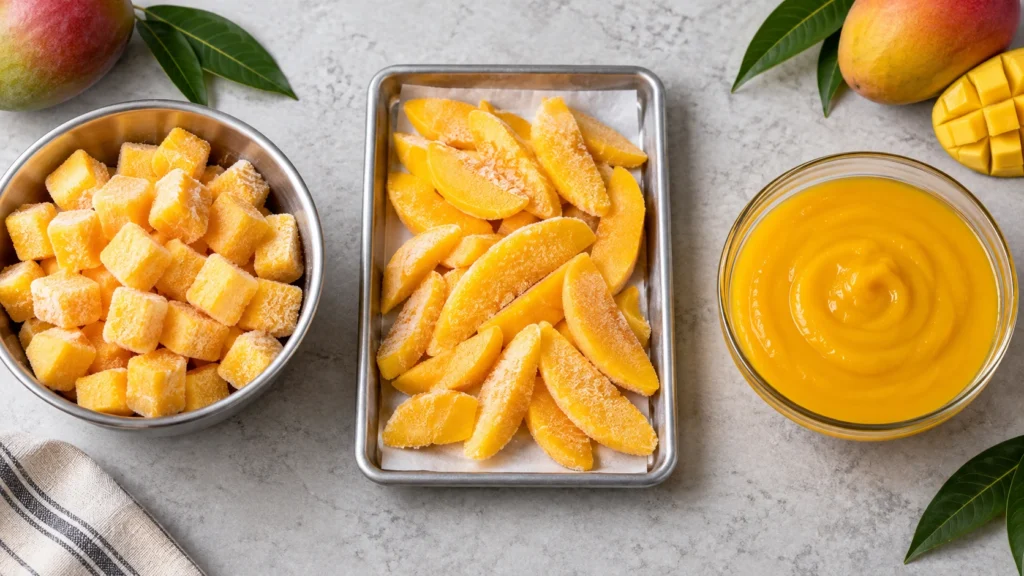
IQF mango cubes are individual pieces of mango, peeled, cut to a defined geometry, and frozen individually in an IQF tunnel. Typical cube sizes include 10mm, 15mm and 20mm – these are confirmed per inquiry.
Common end uses:
- Beverage mixes (smoothies, nectars, fruit cocktails).
- Dairy (yogurt with fruit pieces, ice cream, flavoured milk).
- Bakery (muffins, cakes, fruit fillings, toppings).
- Confectionery (fruit bars, gummies, chocolate fillings).
- Retail packs (frozen fruit blends, snack packs).
- Foodservice (smoothie bowls, dessert toppings).
Browse the IQF mango cubes product page for the current product spec.
2. IQF Mango Slices
IQF mango slices are full slices of mango, individually frozen. Typical slice thickness is around 10-15mm, depending on buyer specification.
Common end uses:
- Foodservice garnish (desserts, salads, platters).
- Retail frozen fruit packs.
- Smoothie and acai bowl kits.
- Bakery toppings where visual presentation matters.
- Confectionery and fruit snack inclusions.
Browse the IQF mango slices product page for the current product spec.
3. Mango Puree (Aseptic or Blast-Frozen)
Mango puree is a smooth, sieved mango product. At IBIC Group, mango puree is processed as an aseptic product (bag-in-drum or bag-in-box) or as a blast-frozen product, depending on buyer specification. IQF is not used for smooth purees – the freezing method is matched to the product.
Common end uses:
- Beverage base (juice, nectar, smoothie base, cocktail mixers).
- Dairy (yogurt, drinking yogurt, lassi, ice cream, sorbet).
- Bakery (fillings, glazes, cake batters).
- Baby food (single-ingredient or blend purees).
- Sauces, dressings, marinades, chutneys.
- Confectionery (gummies, jellies, pastilles).
Browse the mango puree product page for the current product spec.
How IQF Mango Is Processed - Simple & Visual
The IQF process used for mango cubes and slices is the same IQF process used for other fruit pieces. This explanation stays descriptive – no unsupported claims about quality, ranking or performance. The detailed step-by-step version is in our complete guide to IQF technology.
Stage 1 – Raw Material Sourcing
Fresh mango is sourced from contracted Egyptian growers during the harvest window. At receipt, the raw material is checked for variety, maturity, condition at delivery, and traceability documentation.
Stage 2 – Incoming Inspection
Each incoming lot is inspected at the facility. Visual checks, brix/acidity testing where applicable, and temperature-at-delivery verification are standard. Only lots that pass incoming inspection are released to processing.
Stage 3 – Washing and Peeling
Mango is washed in chlorinated water baths, rinsed, and peeled.
Stage 4 – Cutting
The fruit is cut to the agreed geometry (cube size or slice thickness) on the production line, with manual or optical sorting to remove defective pieces, fibre clumps, and any residual peel or stone fragments.
Stage 5 – IQF Freezing
Cut mango pieces move through an IQF freezing tunnel where cold air (below -35°C in IBIC’s specification) circulates at high velocity around each individual piece. Each piece freezes separately rather than as a block.
Stage 6 – Packaging
Frozen product moves into temperature-controlled packaging rooms. Bulk formats (10 kg, 15 kg, 20 kg cartons), foodservice packs (1 kg, 2.5 kg, 5 kg), and retail bags (400 g, 500 g, 1 kg) are typical.
Stage 7 – Metal Detection and Pre-Shipment Inspection
Packed product passes through metal detection and is held for pre-shipment inspection: visual grading, weight verification, and laboratory sampling where required.
Stage 8 – Cold Storage and Container Loading
Approved product is stored at -18°C or below. When the shipment is ready, containers are pre-cooled to target temperature and loaded under documented protocols to maintain cold-chain integrity through transit.
For the IQF technology detail and FAQ, see How IQF Works.
Mango Puree: Typical Specifications
Mango puree specifications vary by variety, harvest year, and buyer specification. The figures below are general industry guidance ranges – your final specification sheet is issued by IBIC per inquiry.
| Parameter | Typical range (general industry guidance) |
|---|---|
| Brix (corrected) | 14 - 17 °Bx (concentrate) or 12 - 15 °Bx (single strength) |
| Acidity (as citric acid) | 0.4 - 0.7 % |
| pH | 3.5 - 4.2 |
| Colour | Yellow to deep orange (variety dependent) |
| Aroma | Characteristic of ripe mango, no off-notes |
| Foreign matter | None |
| Shelf life (frozen, -18°C) | Typically 18-24 months from production |
| Packaging | Aseptic bag-in-drum (~215-230 kg) or bag-in-box (~20-25 kg); blast-frozen in drums or cartons |
Final specification, including the exact brix target, acidity, sieve size, and packaging, is confirmed per inquiry. Third-party laboratory testing is available on request.
Packaging Options for International Buyers
IBIC Group offers flexible packaging for mango products:
- Bulk industrial cartons – typically 10 kg, 15 kg, or 20 kg poly-lined cartons, palletised.
- Foodservice packs – 1 kg, 2.5 kg, 5 kg packs for kitchen operators and catering.
- Retail bags – 400 g, 500 g, 750 g, 1 kg printed bags (private label or La Vida brand).
- Aseptic bag-in-drum – typically 215-230 kg per drum for mango puree.
- Aseptic bag-in-box – typically 20-25 kg per box for mango puree.
- Blast-frozen drums – for puree customers who require frozen delivery.
Packaging format is selected based on the buyer’s intent (manufacturing, foodservice, retail, private label) and the destination market’s labelling requirements. For private-label buyers, the Private Label services team handles artwork adaptation, multi-language labels, and retailer compliance.
Common B2B Applications
Below is a non-exhaustive summary of where IQF mango and mango puree typically end up in B2B programmes. The list reflects standard industry use cases; it is not a claim about any specific buyer or programme.
Beverage Manufacturers
- Smoothie bases (fruit blends).
- Nectars and juice drinks.
- Cocktail mixers.
- Beer, cider, and wine fruit infusions.
Dairy and Ice Cream
- Stirred and drinking yogurt with fruit pieces.
- Ice cream and gelato inclusions and ripples.
- Flavoured milk.
- Lassi and ayran-style drinks.
Bakery and Confectionery
- Fruit fillings for cakes, muffins, pastries.
- Toppings for tarts and cheesecakes.
- Confectionery centres (fruit jellies, pastilles).
- Chocolate bar inclusions.
Baby Food
- Single-ingredient mango puree.
- Mango blends (with apple, banana, pear, etc.).
- Smoothies for older infants (subject to destination regulation).
Ready Meals, Sauces and Marinades
- Mango chutney.
- Curry bases.
- Glazes for meat, poultry, fish.
- Salad dressings and dips.
Retail and Foodservice
- Frozen fruit packs for home smoothie use.
- Smoothie bowl kits.
- Dessert toppings.
- Salad and poke bowl additions.
For each of these applications, the right format is different – cubes for inclusion in a stirred yogurt, slices for a smoothie bowl kit, puree for a beverage base. Buyers typically run more than one format in parallel.
What to Ask Your IQF Mango Supplier - B2B Checklist
Before you confirm a mango programme, walk through this checklist with your supplier. It surfaces the operational details that determine whether a programme succeeds.
- Variety – what mango varieties are available this season, and what is the brix at receipt?
- Format and geometry – cube size, slice thickness, sieve size for puree, with tolerance.
- Brix and acidity targets – corrected brix and acidity range, with method.
- Packaging format and weight – exact pack weight and tolerance, bag-in-drum or bag-in-box for puree.
- Labelling – multi-language requirements, retailer compliance, barcode format.
- Certifications applicable to mango – which certifications cover the specific product and producing site (not all certifications cover all products).
- Lab testing – microbiological, pesticide residue, heavy metals – and which lab performs each test.
- Pre-shipment inspection – sampling plan, lab turnaround, who attends PSI.
- Cold chain documentation – temperature loggers, container pre-cooling records, transit monitoring.
- Lead time and MOQ – production slot, container availability, MOQ per SKU.
- Payment and Incoterms – typically T/T or LC; FOB, CIF or DDP depending on the buyer.
- References – current customers in your destination market or category.
If a supplier hesitates on any of these, treat it as a signal. A serious OEM partner will provide this information in writing.
Certifications & Documentation
IBIC Group’s credentials, with the exact wording from our certification documents, are:
- ISO 9001:2015 – Quality Management Systems.
- ISO 22000:2018 – Food Safety Management Systems.
- FSSC 22000 – Food Safety System.
- GLOBALG.A.P. – Good Agricultural Practices (sourcing).
- GLOBALG.A.P. GRASP – Social Practice Assessment (sourcing).
- U.S. FDA Food Facility Registration.
- Kosher – Religious Dietary Compliance (held for selected Belevini juices; coverage for specific mango SKUs is confirmed per inquiry).
For mango specifically, request the certificate copy that matches the entity, site and product you are ordering. For mango puree in particular, confirm whether Kosher scope applies to the SKU you intend to buy.
Each mango shipment is supplied with:
- Certificate of Analysis (COA) per lot.
- Certificate of Origin.
- Phytosanitary certificate (where required).
- Health certificate (where required).
- Commercial invoice and packing list.
- Bill of lading.
- Third-party laboratory results (on request).
Lead Time, MOQ and Logistics
- Production window – September-October 2026 peak.
- MOQ – typically one 40-foot reefer for finished retail or foodservice SKUs; smaller quantities may be possible for select products or repeat orders.
- Lead time – depends on the SKU, packaging and certification scope; typically 3-6 weeks from order confirmation to ex-factory readiness during peak season.
- Container loading – pre-cooled reefers, with temperature loggers on request.
- Languages – export teams operate in English, Arabic, Italian and Russian.
Lock In Your 2026 Mango Programme
The 2026 Egyptian mango season is open and IBIC Group is taking orders for IQF mango cubes, IQF mango slices, and mango puree. Whether you need bulk industrial supply for a beverage or dairy programme, foodservice packs, retail private-label bags, or aseptic puree drums, the export team can respond with a current offer, a specification sheet, and sample availability.

Egyptian mango harvest typically runs from mid-summer into early autumn, with peak volumes in late summer. For 2026, the peak window is open. Specific start and end dates depend on variety and growing zone and are confirmed per inquiry.
IBIC Group offers IQF mango cubes (10mm, 15mm, 20mm typical), IQF mango slices (typical thickness 10-15mm), and mango puree (aseptic bag-in-drum, bag-in-box, or blast-frozen). IQF is used for cubes and slices; mango puree is processed aseptic or blast-frozen to match the product.
Cubes are mango pieces cut to a defined cubic geometry (commonly 10mm, 15mm, 20mm). Slices are full mango slices of defined thickness. Cubes are typically used where the mango is an inclusion (yogurt, ice cream, bakery filling); slices are typically used where visual presentation matters (smoothie bowls, dessert garnish, retail packs).
General industry guidance: brix 14-17 °Bx for concentrate, 12-15 °Bx for single strength, and acidity 0.4-0.7 % (as citric acid). Final specifications are confirmed per inquiry and on the Certificate of Analysis for the actual lot.
Under correct frozen storage at -18°C or below, IQF mango typically has an 18-month shelf life from production. Mango puree (aseptic) typically has a longer shelf life depending on packaging and storage; the exact figure is on the lot-specific Certificate of Analysis.
IBIC holds ISO 9001:2015, ISO 22000:2018, FSSC 22000, GLOBALG.A.P., GLOBALG.A.P. GRASP, U.S. FDA Food Facility Registration, and Kosher certification for selected Belevini juices. Coverage varies by product, entity and production site – the certificate copy relevant to the specific mango SKU is provided on request.
Yes. Sample availability is confirmed per inquiry. Indicate the format, cube size / slice thickness / brix target, and destination market, and the export team will respond with sample availability and shipping options.
For most mango SKUs, the minimum order is one 40-foot reefer container. For select formats and repeat orders, smaller quantities may be possible. The exact MOQ for your SKU is confirmed in the offer.
Yes. IBIC’s Private Label services programme covers retail IQF mango in custom bags, cartons, and multi-language labels. Private-label MOQ is typically one 40-foot container.
Organic certification is product- and farm-level specific. Contact the export team with your organic requirements to confirm availability for the 2026 season.
Mango is held at -18°C or below from storage through container loading. Containers are pre-cooled to target temperature before loading. Temperature loggers are placed inside during transit on request, and the readings are reviewed at destination.
Yes. IBIC Group exports to 14+ countries across Europe, North America, the GCC, Russia, and Africa. See the Export Markets page for current country availability per product.