If you buy frozen fruit, frozen vegetables, or fruit purees for a food-manufacturing, foodservice, or retail programme, the term IQF appears on almost every supplier’s spec sheet. But what does IQF actually mean, how does the process work step by step, and why does it matter for the finished product in your facility?
This guide explains how IQF (Individually Quick Frozen) technology works, how it compares with conventional block freezing, and how IBIC Group applies it at our IQF processing facility in Zifta, Gharbia Governorate, Egypt. Whether you are an existing buyer auditing a new supplier or a brand evaluating your first IQF programme, the framework below will help you ask better questions and judge the answers you get.
What Does IQF Stand For?
IQF stands for Individually Quick Frozen. The process freezes each piece of fruit, vegetable, or puree particle separately, rather than as a solid block, by exposing it to very cold air at high velocity for a short period. The result is a free-flowing product in which every piece can be poured, measured, and portioned individually — which is exactly what food manufacturers, dairy producers, beverage blenders and foodservice operators need.
At IBIC Group, IQF is the foundation of our frozen fruit and vegetable programme. For formats that IQF is not suited to — for example, smooth fruit purees — we use blast freezing to lock in freshness. The freezing method is selected based on the product and the buyer’s specification.
IQF vs Block Freezing: What’s the Difference?
To understand why IQF matters, it helps to compare it with the older block-freezing method.
| Dimension | Block Freezing | IQF (Individually Quick Frozen) |
|---|---|---|
| Product form | Frozen as one solid block | Each piece frozen separately |
| Thawing | Must thaw entire block to use | Use only what you need |
| Portion control | Poor — chunk breakage | Excellent — free-flowing |
| Texture after thawing | Mushy, cell damage | Closer to fresh |
| Colour & nutrition | Significant drip loss | Colour and nutrition lock |
| Typical buyers | Low-cost commodity | Manufacturers, foodservice, retail |
For food manufacturers formulating recipes, block-frozen fruit releases cell contents during slow freezing and thawing — turning a 10kg strawberry block into a bag of mush and pink syrup. IQF preserves cell structure, so each piece behaves like a fresh piece once thawed.
The IQF Process Step by Step
IBIC Group’s IQF processing follows a controlled, documented sequence. Each step is traceable and supports the certifications we hold (ISO 9001:2015, ISO 22000:2018, FSSC 22000, GLOBALG.A.P.).
Step 1 — Harvest at Optimal Maturity
Produce is harvested at peak ripeness from contracted Egyptian growers in the Nile Delta — primarily in Gharbia and neighbouring Delta governorates. Timing is critical: harvesting too early reduces sugar content; harvesting too late reduces frozen texture quality. Our procurement team coordinates with growers on variety selection and harvest windows.
Step 2 — Incoming Inspection
Every incoming lot is inspected at receipt. Incoming inspection checks include:
- Visual grading (size, colour, defects)
- Brix / acidity testing for fruit (where applicable)
- Temperature at delivery (cold chain integrity)
- Pesticide-residue documentation per supplier records
- Variety confirmation against the purchase specification
Only lots that pass incoming inspection are released to processing.
Step 3 — Washing and Cleaning
Produce is washed in chlorinated water baths to reduce surface microbial load, then rinsed with potable water. Leaves, stems and foreign material are removed.
Step 4 — Peeling, Cutting and Sorting
Depending on the buyer specification, produce is peeled (where required), then cut into the agreed geometry — for example:
- Mango cubes (typically 10mm, 15mm or 20mm)
- Mango slices
- Whole guava (peeled or unpeeled)
- Pomegranate arils
- Strawberry halves or whole
- Broccoli florets
- Mixed vegetable blends
Optical and manual sorting stations remove defective pieces, off-colour items, and any residual foreign matter.
Step 5 — Blanching (Vegetables Only)
Most frozen vegetables are briefly blanched (steam or hot water) to inactivate enzymes that would otherwise cause off-flavours and colour drift during frozen storage. Fruit is generally not blanched. Blanching time and temperature are product-specific and validated by the QA department.
Step 6 — IQF Freezing
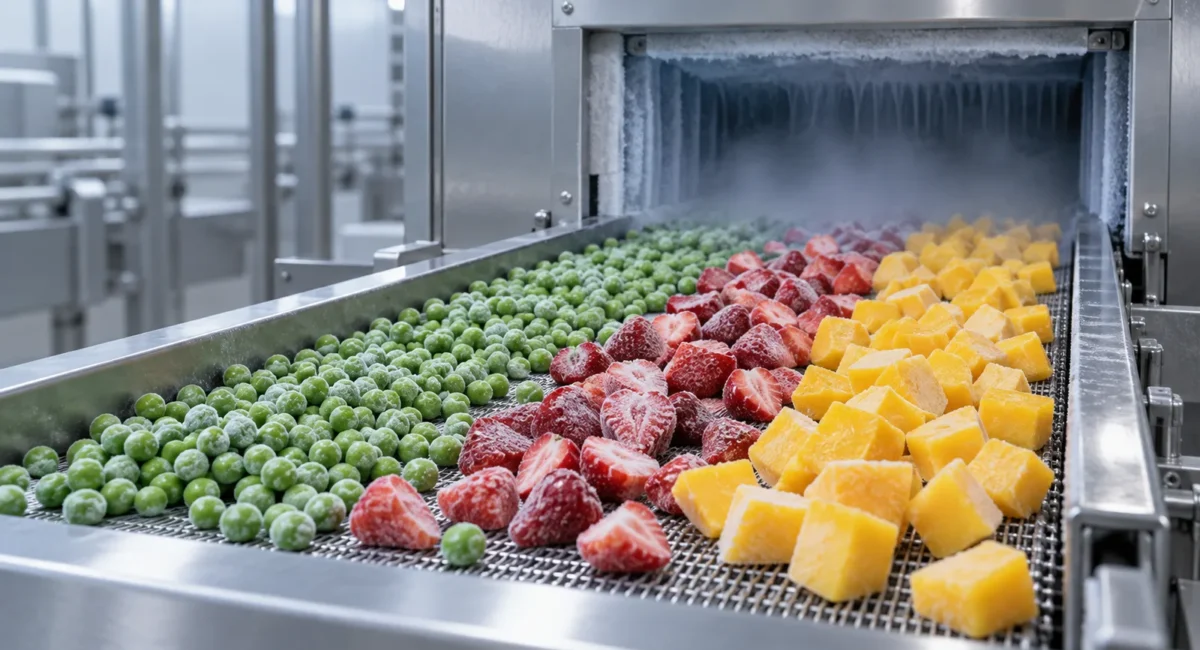
This is the heart of the process. Products enter an IQF tunnel — a long, insulated chamber in which very cold air (below -35°C in IBIC’s specification) circulates at high velocity around each individual piece.
The freezing happens in two phases:
- Pre-freezing surface: a thin ice crust forms on each piece within seconds, locking in cell moisture.
- Core freezing: heat is drawn out of the piece until its centre reaches the storage temperature.
Because each piece is frozen individually and rapidly, ice crystals stay small. Small ice crystals mean less cell damage — which is why IQF fruit thaws closer to fresh fruit than block-frozen fruit does.
Step 7 — Glazing (Optional, Product-Specific)
Some IQF products — particularly whole fruit and seafood-adjacent items — receive a thin protective glaze (a water or citrus-based ice coating) to prevent dehydration during storage. Glazing is specified by the buyer.
Step 8 — Packaging
Frozen product moves immediately from the IQF tunnel to the packaging line. IBIC offers flexible packaging across formats:
- Bulk industrial: 10kg, 15kg, 20kg cartons; poly-lined; palletised.
- Foodservice: 1kg, 2.5kg, 5kg packs.
- Retail: 400g, 500g, 750g, 1kg printed bags.
- Private label: custom artwork, multi-language labels, retailer-specific barcodes.
All packaging occurs inside temperature-controlled rooms to prevent thaw/refreeze cycles.
Step 9 — Metal Detection and Pre-Shipment Inspection
Finished packed product passes through metal detection and is held for pre-shipment inspection. Pre-shipment checks include net weight verification, count checks (where applicable), visual grading, and sampling for laboratory analysis (microbiological, pesticide residue, and compositional where required).
Step 10 — Cold Storage and Container Loading
Approved product is moved into cold storage at -18°C or below. When the shipment is ready, containers are pre-cooled to the target temperature before loading, then loaded under documented protocols to maintain cold-chain integrity through ocean transit and destination handling.
Why IBIC Uses IQF — and What It Means for Buyers
IBIC Group uses IQF for the products where it delivers the greatest buyer benefit: free-flowing fruit pieces, vegetable cuts, and blends. For smooth fruit purees we use blast-freezing, which is the appropriate technology for that product form. The freezing method is matched to the product and the buyer’s end use — never a one-size-fits-all approach.
What IQF means in practice for our B2B partners:
- Better yield — less drip loss in your factory means more usable product per kilogram purchased.
- Cleaner recipes — IQF pieces hold their shape in bakery, dairy, beverage and ready-meal applications, so your finished product looks better on the shelf or plate.
- Lower waste — you can portion exactly what you need from a 10kg carton without thawing the rest.
- 18-month shelf life — under correct frozen storage, our IQF range delivers reliable 18-month shelf stability.
- No additives — IQF preserves the product without preservatives, additives or anti-caking agents (unless you request glazing or specific treatments).
Products That Benefit Most from IQF
Not every product is a perfect IQF candidate. Based on what we ship, these categories consistently benefit most:
- IQF strawberry halves and whole — for jam, bakery, dairy, beverage.
- IQF mango cubes and slices — for beverage, dairy, ready-meal, retail.
- IQF pomegranate arils — for retail, foodservice garnish, dairy.
- IQF guava whole and puree — for beverage, dairy, baby food.
- IQF broccoli, okra, mixed vegetables — for foodservice, ready-meal, retail.
- IQF spinach, molokhia, coriander — for foodservice and retail.
For fruit purees, our fruit puree range uses blast-freezing and aseptic packaging matched to each product.
Certifications That Back the Process
IBIC’s IQF process is delivered under a documented quality and food-safety management system. The exact wording on our published credentials is:
Certification coverage varies by product, activity, supplying entity and production site. The credentials below should be read alongside their applicable scopes. Please request the documentation relevant to your proposed order.
- ISO 9001:2015 — Quality Management Systems.
- ISO 22000:2018 — Food Safety Management Systems.
- FSSC 22000 — Food Safety System.
- GLOBALG.A.P. — Good Agricultural Practices (sourcing).
- GLOBALG.A.P. GRASP — Social Practice Assessment (sourcing).
- U.S. FDA Food Facility Registration.
- Kosher — Religious Dietary Compliance (selected Belevini juices).
Visit our Certifications, Registrations & Assessments page for the full list with certificate scopes, holders and validity.
Frequently Asked Questions
Answers to the questions buyers ask most about IQF fruit and vegetables.
What does IQF stand for?
IQF stands for Individually Quick Frozen — a freezing process that freezes each piece of fruit, vegetable or puree particle separately, rather than as a solid block. The result is a free-flowing product with better texture, colour and portion control than block-frozen product.
How is IQF different from regular frozen food?
Conventional frozen food is often block-frozen — the product freezes together as a single mass. IQF freezes each piece individually using very cold air at high velocity, which preserves cell structure, prevents clumping, and allows the buyer to portion only what is needed without thawing the whole pack.
What temperature does IQF freezing use?
IBIC Group’s IQF tunnels operate at below -35°C to freeze product rapidly. Finished product is then held in cold storage at -18°C or below to maintain quality through to the buyer’s facility.
Does IQF affect nutrition?
IQF preserves nutritional value better than slow freezing because rapid freezing forms small ice crystals inside each cell, minimising cell rupture. Vitamins, minerals and natural colour are largely retained — typically better than in block-frozen or canned equivalents.
Are preservatives added to IQF products?
No. Pure IQF fruit and vegetables contain no preservatives, no additives and no anti-caking agents unless the buyer specifically requests a treatment such as glazing. The IQF process itself is the preservation method.
What is the shelf life of IQF products?
Under correct frozen storage at -18°C or below, IBIC Group’s IQF fruit and vegetable products have a typical 18-month shelf life from the date of production.
Can IQF fruit and vegetables be used straight from frozen?
Yes. Most IQF products are designed for direct use from frozen — they go straight into the recipe, mixer or fryer without thawing. This is one of the key operational advantages for food manufacturers and foodservice operators.
What IQF products does IBIC Group offer?
IBIC offers a full range of IQF fruits (mango, strawberry, guava, pomegranate, grapes, peach, fig, apricot, pineapple) and IQF vegetables (broccoli, okra, spinach, mixed veg, sweet corn, green beans, peas & carrots, mushroom, cauliflower, molokhia, and more). View the IQF frozen fruit range and the IQF frozen vegetable range.
What is the difference between IQF and blast freezing?
IQF freezes individual pieces separately in a tunnel of cold moving air. Blast freezing freezes larger portions (such as purees or block packs) in a cold-air chamber. IBIC uses IQF for fruit pieces and vegetable cuts, and blast freezing for fruit purees — the method is matched to the product.
Can private-label IQF products be custom-produced?
Yes. The Private Label service covers product selection, custom packaging, labelling, and export logistics for retailers and brands. Minimum order for private-label production is typically one 40-foot container. Read more on our Private Label services page.
Bring IQF Quality to Your Programme
IBIC Group manufactures IQF fruit and vegetables under one of the most rigorous quality frameworks in the Egyptian frozen-food industry. Whether you are sourcing IQF mango cubes, IQF strawberries, IQF pomegranate arils, or a custom vegetable blend, our export team can supply samples, specifications, and quotations tailored to your destination market.
About the author
This article was prepared by the IBIC Group Editorial Team and reviewed by the IBIC Quality Assurance Department. IBIC Group is an Egyptian food manufacturer and exporter of IQF frozen fruits, frozen vegetables, fruit purees, canned foods, grilled vegetables, and juice products, operating from the Nile Delta since 2015.